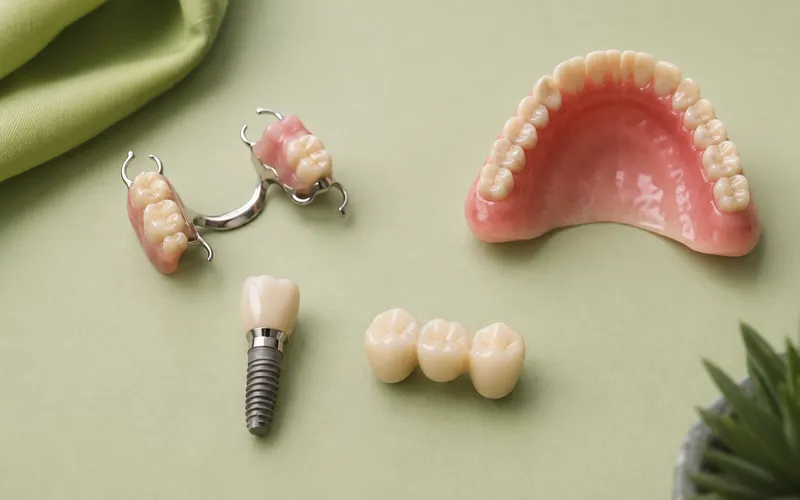
"Isn't she too old for that?" is a question families ask when a parent or grandparent is offered dental implants in their late seventies or eighties. It is a fair question, but it is usually the wrong one. Research on older patients suggests that age by itself is not what decides whether implants work. What decides it is health, medication, bone, and above all whether the person can live with and look after what is built.
What the research on older patients actually found
The most useful summary comes from a systematic review and meta-analysis prepared for an international implant consensus conference. It pooled studies on patients aged 75 and older and found a one-year implant survival of about 97% and a five-year survival of 96.1%, based on three studies for the five-year figure (Schimmel et al., Clinical Oral Implants Research, 2018). The authors concluded that these rates were similar to those reported in younger groups and that advanced age did not appear to harm the process by which an implant fuses with bone.
Two caveats come with that finding. First, the review reported no ten-year data for this age group, so long-term numbers for people who start at 80 remain thin. Second, the authors pointed out that no study looked specifically at very old patients who also had medical conditions, so the combined effect of age plus illness is not well understood. Those caveats are reasons for careful planning, not reasons to refuse.
Why age is the wrong yardstick
Think about two people aged 82. One walks daily, manages her own medications, has good hand strength and lives independently. The other has advanced Parkinson's disease, needs help dressing and takes several drugs that cause a dry mouth. Their birth years are identical. Their suitability for a complex implant plan is not.
Dentists who treat older people tend to sort the decision into four areas:
- Medical risk of the surgery itself. Heart conditions, anticoagulants, uncontrolled diabetes and certain bone medications.
- Biological healing. Bone quantity and quality, past radiotherapy to the jaws, smoking.
- Daily maintenance. Eyesight, dexterity, memory, and whether a carer can help.
- Life expectancy and goals. Not in a morbid sense, but practically: how many years of comfortable eating is the treatment meant to provide, and how long does it take to get there?
Health conditions that matter more than age
The same review looked at several conditions that become more common later in life. Here is what it reported, in plain terms.
| Condition | What the 2018 review reported | What that means for planning |
|---|---|---|
| Diabetes | Survival ranged from 86.3% to 100% across studies; poor control (HbA1c 8% or higher) may influence results | Control matters more than the diagnosis; involve the GP |
| Osteoporosis on low-dose drugs | Survival was predominantly high; jaw osteonecrosis risk with low-dose bisphosphonates estimated as very low | Tell the dentist exactly which drug, dose and for how long |
| High-dose bone drugs (e.g. for cancer) | Implant placement described as contraindicated | Usually rules out implants; alternatives needed |
| Radiotherapy to the head and neck | Survival lower and more variable | Specialist planning; the review suggested waiting over 12 months after radiotherapy where possible |
| Parkinson's disease | Only small studies; survival from 82.1% to 100% | The bigger issue is cleaning and handling, not fusion |
| Cardiovascular disease | Survival similar or higher; main concern is surgical risk from anticoagulants and some anaesthetics | Coordinate with cardiologist or GP before surgery |
All figures above are from Schimmel et al., 2018. They describe the studies included in one review, not your personal odds. If any of these apply, we cover several of them in more detail in smoking, diabetes and bone drugs.
The point families most often miss: who will clean it?
The review authors made an observation that should be printed on every treatment plan for an older patient. An implant can fuse perfectly with the bone and still be useless if the prosthesis on top is too complicated for the person to use and maintain. In their words, that cannot be considered a successful treatment in this population (Schimmel et al., 2018).
This is why the "best" restoration for an 80-year-old is often not the most impressive one. A fixed full-arch bridge looks and feels most like natural teeth, but it has to be cleaned underneath with special brushes or water flossers, and a professional has to remove it periodically. If arthritis, tremor or memory loss sets in, that becomes hard. A removable denture held by a few implants can be lifted out and cleaned at a sink by the person or a carer.
Plan for the person you will be in ten years
A practical question to ask the dentist: if my hands or memory get worse, can this design be simplified? Some plans allow a fixed bridge to be converted to a removable overdenture later using the same implants. Others do not. Building in that flexibility is a quiet sign of a thoughtful plan.
Options that often suit older patients
Two implants under a lower denture
Lower complete dentures are notoriously unstable because the tongue and the shape of the jaw keep lifting them. Two implants with attachments let the denture click into place while remaining removable. It involves less surgery than a fixed arch and is easy to clean. We explain the mechanics in snap-in dentures explained.
A well-made conventional denture
For some people the right answer is no surgery at all. A new denture made with care, then adjusted and relined as needed, can still be a good outcome, particularly when health makes surgery risky. There is no shame in that choice.
Fixed full-arch teeth
For a fit, independent older adult who wants teeth that do not come out, a fixed arch can be entirely reasonable. The plan simply needs to include the maintenance schedule and an honest discussion of what happens if circumstances change.
A single implant to fill one gap
Sometimes the question is not full replacement but one lost molar. For a healthy older adult this is usually a modest procedure, and the review's findings on survival are reassuring.
Preparing for surgery as an older patient
- Bring a complete medication list, including supplements and anything taken weekly, monthly or by injection.
- Ask the dentist to write to your GP or specialist; the review authors recommended individual risk assessment with the family doctor and relevant specialists.
- Discuss sedation: who gives it, where, and what monitoring is used.
- Arrange a companion for the day of surgery and the first night.
- Plan soft meals and hydration for the first days, especially if appetite is poor.
- Ask how many appointments the whole plan needs and whether they can be grouped to reduce travel.
Time to benefit: the question nobody likes to ask
Every implant plan has a waiting period built into it. There may be extractions, healing, perhaps a graft, the implant fusing with bone, and then the final teeth. For a younger patient those months are a small slice of the decades ahead. For someone in their late eighties, they are a bigger slice, and it is reasonable to ask how quickly the plan delivers comfortable chewing.
Some approaches shorten the gap: attaching a denture to implants sooner where bone allows, or keeping a well-fitting existing denture in use while healing happens underneath. Others, such as staged grafting, lengthen it. Asking the dentist "when will I be eating normally again, realistically?" is not pessimistic. It is part of choosing a plan that fits the life being lived now, and the honest answer may tip the balance between a simpler and a more ambitious option.
When a family member is helping decide
Adult children often join these conversations, sometimes from another city. A few things help. Let the patient speak first about what bothers them: a loose lower denture, pain when chewing, embarrassment when smiling. Those goals should drive the plan. Ask the dentist to explain the options in terms of daily life, not only clinical terms. And separate two questions that often get blurred: can this be done safely, and is it worth doing for this person now?
Sometimes the honest answer is yes and yes. Sometimes it is yes, but a simpler version. And occasionally it is not now, because another health priority comes first. None of those answers is about age alone.
The bottom line
Being 75 or 85 is not, on its own, a reason to rule out implants. The evidence in older adults is limited but encouraging for survival in the short and medium term. The more important questions are about medical safety, healing, and whether the final teeth can be cleaned and handled for years to come. Plans that keep things simple and adaptable tend to serve older patients best. For daily care, see cleaning around dental implants.
For older travellers, the trip itself deserves as much planning as the dentistry: direct flights, a companion, a stay close to the clinic, and a written plan your family doctor has seen. Ask clinics how they coordinate with a patient's physician before sedation. Compare provider options at colombiadentist.co, full-mouth cases at fullmouthrestoration.co, or start at the network hub, colombiamedical.co.
Frequently asked
Is there an upper age limit for dental implants?
There is no fixed cut-off in the research we reviewed. A systematic review of patients aged 75 and older found implant survival over one and five years similar to that of younger groups. Decisions are usually made on overall health, bone, medications and the ability to look after the result, not on the number of birthdays.
My parent has early memory problems. Should we avoid implants?
Not automatically, but it changes what kind of design makes sense. Researchers in this field stress that a restoration the person cannot clean or handle is not a success. A simpler, removable design that a carer can manage may be wiser than a complex fixed bridge.
Do blood thinners rule out implant surgery?
Not in themselves, but they need planning. Surgical teams usually coordinate with the prescribing doctor about bleeding risk, and some local anaesthetics with vasoconstrictors need care in people with heart conditions. Never stop a blood thinner on your own to prepare for dental surgery.
Are two implants under a lower denture enough for an older person?
For many people it is a common and well-regarded option, because it turns a floating lower denture into one that clicks into place while staying easy to remove and clean. Whether two is right for a given mouth depends on bone, the upper teeth and how much stability the person wants.
Can implants be placed if someone is in a care home?
It happens, but the bigger question is who will clean them daily and who will remove and clean an overdenture. Before treatment, it helps to involve the care team and confirm that someone is trained and willing to do it.
All prices are typical 2026 ranges drawn from published US self-pay data and Colombian clinic price lists, not quotes. USD/COP moved from roughly 3,805 to 3,070 during 2026, so dollar figures for Colombia have risen versus older articles. Only a clinic that has reviewed your scan can give you a real number. This is educational content, not medical advice.