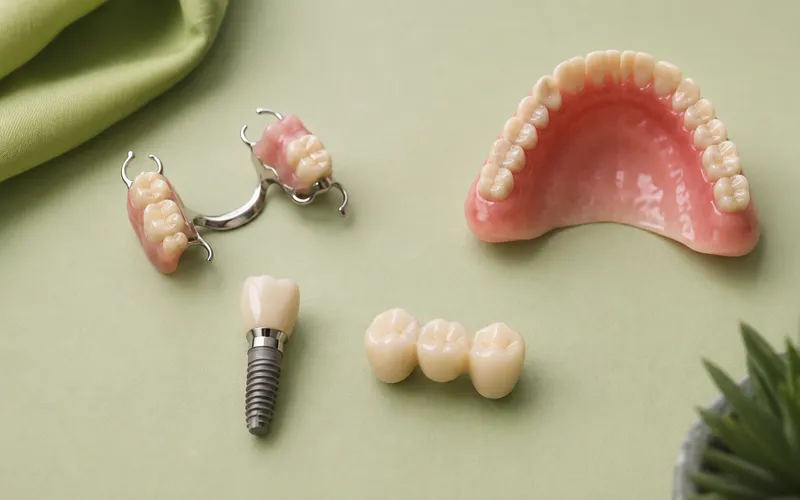
Most people who hate their dentures do not hate the teeth. They hate the movement: the lower denture that lifts when they laugh, the adhesive, the fear of biting into anything with a crust. A snap-in denture fixes the movement without the price of a fixed bridge. Two to four implants go into the jaw, the denture gets matching sockets, and it clicks down onto them. You still take it out at night. You no longer worry about it in a restaurant.
How it actually works
There are two common attachment systems. Locator-style attachments are individual studs on each implant with nylon inserts in the denture; they are simple, cheap to maintain, and the inserts get swapped every year or so as they wear. Bar-retained systems join the implants with a metal bar and the denture clips onto the bar; they are more rigid, more expensive, and need more room in the denture. Most two-implant lower cases use Locators.
Two implants is the accepted minimum for a lower overdenture and is often called the standard of care for the edentulous lower jaw in the dental literature. The upper jaw is different: it has softer bone and the palate to cover, so upper overdentures generally want four implants, and some patients skip straight to a fixed arch for the upper.
Who it suits
- People with an existing full denture that fits reasonably but will not stay put.
- People whose budget is a fraction of a fixed arch, especially for the lower jaw.
- People with significant bone loss where a fixed arch would need extensive grafting; overdenture implants can often go in the front of the jaw where bone lasts longest.
- People who want something they can clean by taking it out.
Who it does not suit
If the idea of removable teeth is the problem, no amount of clicking fixes that; look at All-on-4 and All-on-6. If you have a strong gag reflex the upper palate coverage may still bother you, although implant-supported uppers can often be made palateless. And if you grind heavily, the nylon inserts will wear quickly and a bar or fixed option may be better value.
Timeline
If you already have a denture, the implants can often be placed and the denture temporarily relined in one visit, with the snap attachments added after three to four months of healing. Some clinics use immediate-load Locators on the lower jaw when bone is dense. If you need new dentures too, add two to three weeks for fabrication. Across two trips or one, this is one of the shorter full-mouth journeys.
Maintenance you should budget for
Inserts: replaced roughly yearly, a few dollars each. Relines: every two to three years as the ridge continues to change. Denture replacement: every seven to ten years. The implants themselves, cared for, should last decades. Compared with a conventional denture, you spend more up front and considerably less on adhesive, remakes and sore spots. The 20-year cost comparison runs the numbers.
Two-implant lower overdentures are one of the most cost-effective procedures to travel for, and Colombian clinics commonly complete the implants and a converted denture in a single trip. See the vetted clinics at colombiadentist.co, full-mouth cases at fullmouthrestoration.co, or start at the network hub, colombiamedical.co.
Frequently asked
How many implants does a snap-in denture need?
Two is the accepted minimum for a lower overdenture. Upper overdentures usually need four because upper bone is softer and the denture is larger.
Do snap-in dentures stop bone loss?
They slow it where the implants are, because the bone around each implant is loaded. Bone under the rest of the denture continues to change, which is why relines are still needed.
Can my existing denture be converted?
Often, yes, if it fits well and has enough acrylic thickness for the attachment housings. Worn or thin dentures are usually remade at the same time.
All prices are typical 2026 ranges drawn from published US self-pay data and Colombian clinic price lists, not quotes. USD/COP moved from roughly 3,805 to 3,070 during 2026, so dollar figures for Colombia have risen versus older articles. Only a clinic that has reviewed your scan can give you a real number. This is educational content, not medical advice.