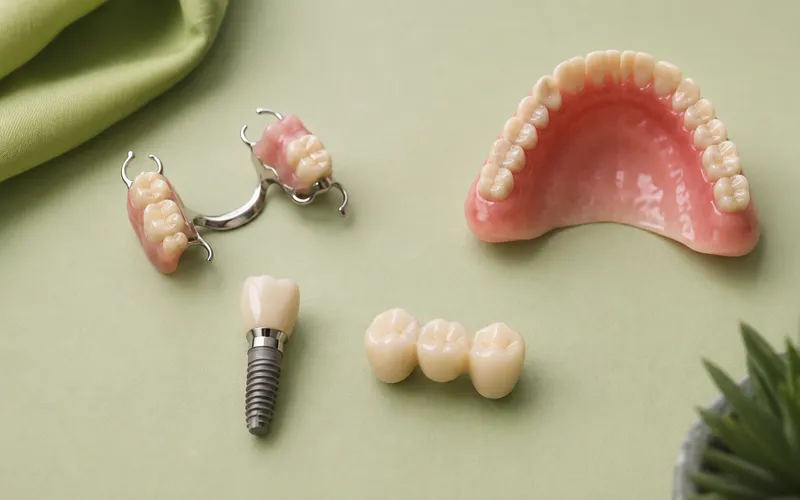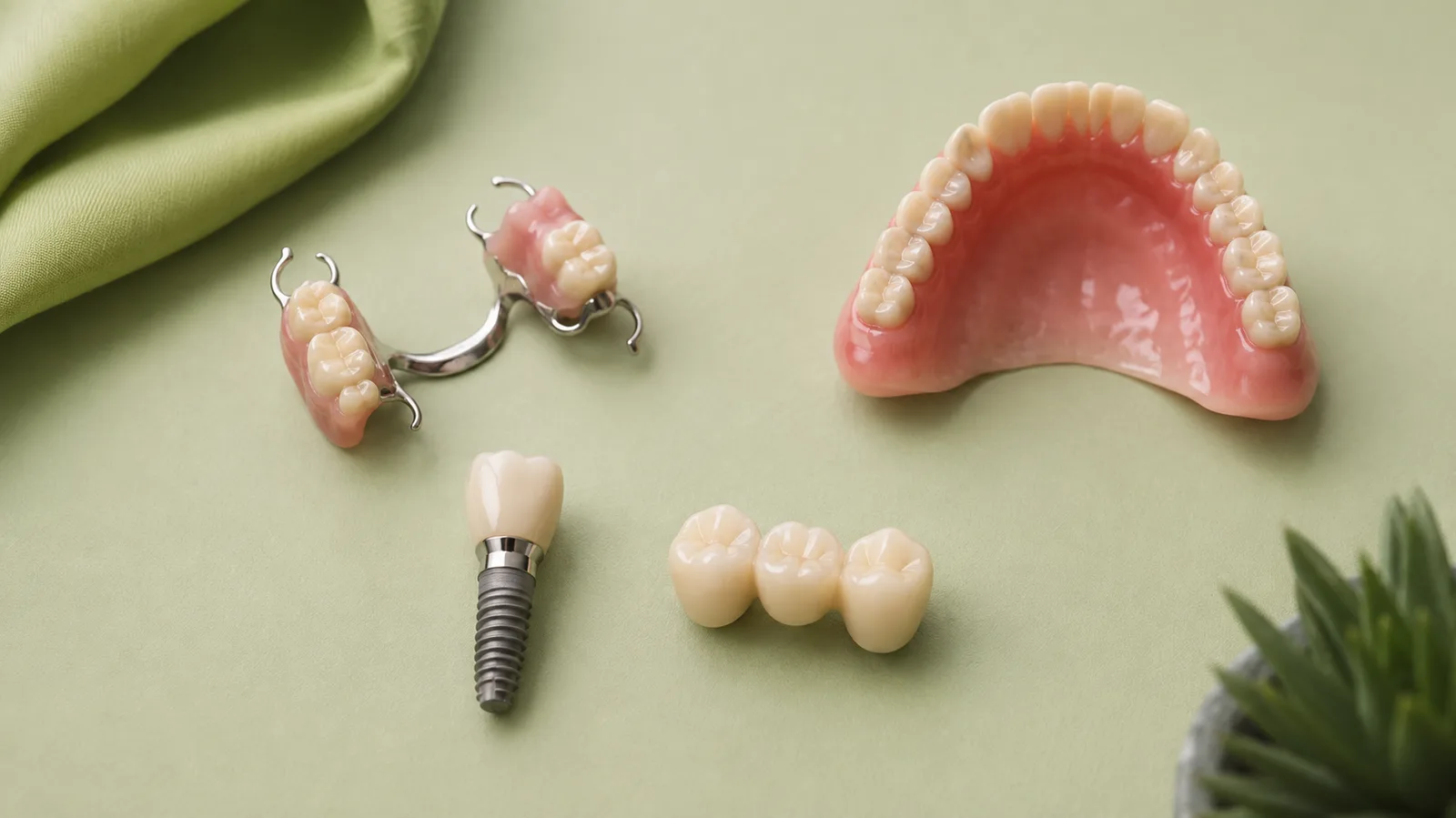
One missing tooth gives you three choices, and each one quietly optimises for something different. An implant optimises for the long run. A bridge optimises for speed and up-front price. A partial denture optimises for spending as little as possible right now. There is no universally right answer, but there is usually a right answer for you, and it depends on four things: the bone under the gap, the condition of the neighbouring teeth, how long you plan to keep the result, and money.
The three options in one table
| Implant + crown | 3-unit bridge | Partial denture | |
|---|---|---|---|
| What it is | Titanium post in the jaw, abutment, ceramic crown | False tooth fused to crowns on the two neighbours | Removable acrylic or metal frame with a false tooth |
| Touches neighbours? | No | Yes: both are ground down for crowns | Clasps rest on them |
| Protects the bone? | Yes, load stimulates the jaw | No, bone under the gap keeps shrinking | No, and pressure can speed loss |
| Typical lifespan | 20+ years; 10-year survival commonly reported above 95% | 10 to 15 years | 5 to 8 years before remake |
| Time to finish | 1 day (immediate load) to 6 months | 2 to 3 weeks | 2 to 4 weeks |
| Typical 2026 US | $3,500 to $6,500 | $3,000 to $5,000 | $1,000 to $2,500 |
| Typical 2026 Colombia | $1,200 to $1,800 | $900 to $1,500 | $400 to $900 |
When an implant is the right call
An implant is the only option that replaces the root, and the root is what keeps the jawbone alive. Bone that is not loaded resorbs; a bridge or denture sitting over a gap does nothing to stop that. If the teeth on either side of the gap are healthy and unfilled, an implant also spares you from cutting them down, which is the part of a bridge that most dentists quietly dislike.
Implants need enough bone to hold the post. If the tooth came out recently, you probably have it. If it came out five years ago, you may not, and the price grows by a graft. That is the single biggest variable in single-implant pricing and the reason a written plan matters more than a website range.
When a bridge makes sense
A bridge is fast, fixed, and cheaper than an implant in most US practices. It is the sensible choice when the neighbouring teeth already need crowns anyway, when there is not enough bone and you do not want grafting, or when a medical condition rules out implant surgery. The trade-off is permanent: those two teeth are crowned for life, and when a bridge fails, you are usually replacing three teeth' worth of work, not one.
When a partial denture is enough
If the gap is a back tooth you cannot see, if money is genuinely the constraint, or if you need something while you save for the permanent fix, a partial denture is a legitimate choice. Just go in with clear eyes: it comes out at night, it moves a little when you chew, and the bone under it keeps changing shape, so it needs adjusting. Think of it as a bridge loan, not a mortgage.
The question that decides it
Ask yourself how long you want to keep this result. If the answer is "the rest of my life," the implant is usually cheaper across that horizon even at US prices, because it does not get remade. If the answer is "until I figure out the bigger plan," a denture or bridge buys time. And if the answer is "I want the implant but not the US bill," that gap is precisely why Colombia exists in this conversation: a single implant with crown there typically lands where a US bridge does, with the same implant brands.
Related reading: what a single implant actually involves, why the age of the gap matters, and the full 2026 cost breakdown.
For a single implant, Colombian clinics use the same Straumann, Nobel Biocare, Neodent and Osstem systems as US practices, and a one-trip immediate-load protocol is often possible if the socket is healthy. See the vetted clinics at colombiadentist.co, full-mouth cases at fullmouthrestoration.co, or start at the network hub, colombiamedical.co.
Frequently asked
Is an implant always better than a bridge?
No. An implant is better for bone health and for sparing the neighbouring teeth, but a bridge is faster, avoids surgery, and is the better choice when the neighbours need crowns anyway or when bone is insufficient and you do not want a graft.
Can I get a bridge now and an implant later?
Yes, but the bridge will have removed enamel from the neighbouring teeth, so those will still need crowns afterwards. If you expect to want an implant eventually, a partial denture is the less destructive placeholder.
How long does a single implant take in Colombia?
If the socket is healthy and bone is adequate, an immediate-load protocol can place the implant and a temporary crown in one trip of five to seven days. If grafting is needed, plan on two trips three to six months apart.
All prices are typical 2026 ranges drawn from published US self-pay data and Colombian clinic price lists, not quotes. USD/COP moved from roughly 3,805 to 3,070 during 2026, so dollar figures for Colombia have risen versus older articles. Only a clinic that has reviewed your scan can give you a real number. This is educational content, not medical advice.