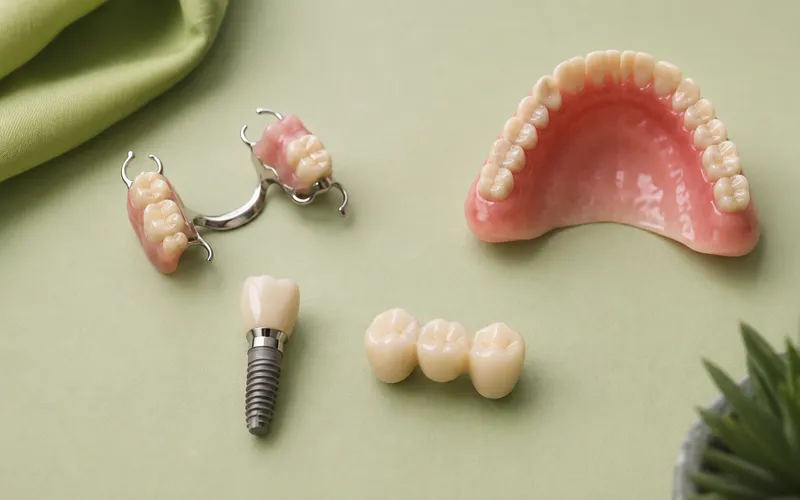
An implant is three parts: a titanium (or zirconia) screw that goes in the bone, an abutment that connects it to the mouth, and a crown that looks like a tooth. The procedure is routine, the recovery is usually mild, and the whole thing can take a day or six months depending on your bone. Here is the sequence so nothing surprises you.
1. Imaging and planning
A CBCT scan (a 3D X-ray) shows bone width, height and density, plus where the nerve and sinus are. From it, the surgeon chooses implant length and diameter and often prints a surgical guide. If the scan shows too little bone, this is where grafting enters the plan. Any clinic that skips the CBCT for an implant is cutting a corner you should not accept.
2. Placement
Under local anaesthetic, sometimes with oral or IV sedation, the gum is opened, a precise hole is drilled, and the implant is threaded in. Placement of a single implant takes 30 to 60 minutes. If the tooth is still present, it is extracted first; in a healthy socket the implant can go in the same day (immediate placement). Some cases also get a temporary crown the same day (immediate load), usually for front teeth where appearance matters and bite forces are lower.
3. Healing: osseointegration
Bone grows onto the implant surface over roughly eight to sixteen weeks in the lower jaw and twelve to twenty-four in the upper. Modern implant surfaces have shortened this, but it cannot be rushed. During this time you wear a temporary crown, a flipper (a small removable tooth), or nothing if it is a back tooth.
4. Abutment and crown
Once integrated, the abutment is attached and a digital impression is taken. A lab makes the crown, typically zirconia or lithium disilicate (e.max), and it is screwed or cemented on. Screw-retained crowns are easier to service later and are increasingly the default.
What it feels like
Most people describe the day after placement as a dull ache managed with ibuprofen, some swelling for two to three days, and a soft diet for a week. Pain that escalates after day three, or numbness that persists, is not normal and needs a call to the clinic. Once the crown is on, the implant has no nerve, so it feels like a slightly "quiet" tooth: solid, but without the sensitivity a natural tooth has.
What it costs in 2026
US self-pay for implant, abutment and crown typically runs $3,500 to $6,500, before grafting or sedation. Colombian clinics typically quote $1,200 to $1,800 for the same three components with named implant brands. Bone grafting adds $1,500 to $3,000 in the US and $300 to $1,000 in Colombia. These are ranges, not quotes; the scan decides the rest. Related: implant success rates and longevity and the day of surgery.
For one tooth, the trip is short and the saving is real but modest in dollar terms. It makes most sense combined with other work, or for a front tooth where you want a specialist and a named implant brand at a lower price. See the vetted clinics at colombiadentist.co, full-mouth cases at fullmouthrestoration.co, or start at the network hub, colombiamedical.co.
Frequently asked
Does getting an implant hurt?
Placement is done under local anaesthetic and is usually less uncomfortable than an extraction. Expect a dull ache and swelling for two to three days, managed with over-the-counter pain relief.
Can I get an implant the same day as the extraction?
Often, if the socket is free of infection and has enough bone. This is called immediate placement. A same-day temporary crown (immediate load) is added in suitable front-tooth cases.
Which implant brands should I look for?
Straumann, Nobel Biocare, Neodent, Osstem, MIS and Zimmer Biomet are widely used in both the US and Colombia and have long published track records. Ask which system will be used and get the implant passport or sticker for your records.
All prices are typical 2026 ranges drawn from published US self-pay data and Colombian clinic price lists, not quotes. USD/COP moved from roughly 3,805 to 3,070 during 2026, so dollar figures for Colombia have risen versus older articles. Only a clinic that has reviewed your scan can give you a real number. This is educational content, not medical advice.