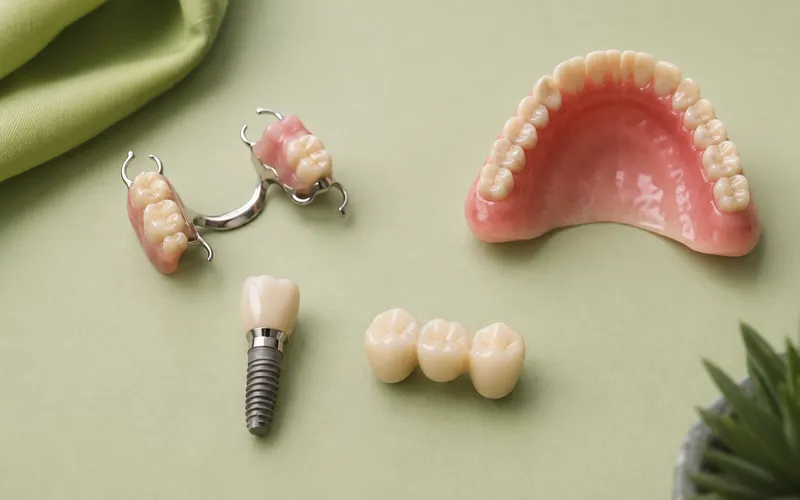
One question catches many people off guard after they agree to an implant: what do I wear in the meantime? Implants often need time to fuse with the bone before the final crown goes on. The AAE notes that implant treatment usually involves several stages over several months, including healing time (AAE, 2026). If the gap is in your smile, those months matter. This guide covers the temporary options for one tooth or a few, and what to weigh when choosing.
Why the temporary matters more than it seems
A temporary tooth is not just cosmetic. A good one protects the healing site, keeps neighbouring and opposing teeth from drifting, and lets you speak and smile normally. A poor one can do harm: a temporary that presses on fresh gum over a healing implant can disturb the site. That is why surgeons often have firm preferences about what you wear, and why it pays to ask before surgery rather than after.
There are two broad categories: removable temporaries you take in and out, and fixed temporaries that stay put. Each has trade-offs.
Removable options
The flipper (acrylic partial)
A flipper is a small pink acrylic plate with one or more false teeth, sometimes with simple wire clasps. It is quick and inexpensive to make, easy to adjust, and familiar to most dentists.
- Good for: front teeth where appearance matters, short-to-medium waits, people on a budget.
- Drawbacks: covers part of the palate or the tongue side, which can feel bulky and affect speech at first. It is gum-supported, so it can press on the healing area unless it is relieved there. It is not made for chewing.
The clear retainer with a tooth (Essix-style)
A thin, clear plastic tray that fits over your teeth, with a tooth-coloured section filling the gap. Because it rests on your natural teeth rather than the gum, it can keep pressure off the healing site.
- Good for: a front gap in someone with healthy neighbouring teeth, especially when the surgeon wants zero pressure on the site.
- Drawbacks: you cannot really eat with it in, and the plastic can wear or crack. It covers the biting surfaces of your teeth, which some people find odd.
Your existing partial denture, modified
If you already wear a partial, it can sometimes be adapted: a tooth added, or the area over the implant relieved so it does not press. This can be the simplest and least expensive route if the partial fits well.
Fixed options
Temporary bonded tooth
A false tooth bonded to the neighbouring teeth, either with a small wing or a fibre-reinforced strip, can give a fixed temporary without touching the implant. It is similar in principle to a resin-bonded bridge, explained in our Maryland bridge guide.
- Good for: people who cannot cope with something removable, and for longer waits where a removable temporary would be impractical.
- Drawbacks: it can debond, and it needs suitable neighbouring teeth. Getting it off later takes a dental appointment.
Temporary crown on the implant
In some cases, the implant is firm enough when placed for a temporary crown to be attached the same day. The crown is usually kept out of heavy contact with the opposing teeth. This is often called immediate provisionalisation or immediate loading, and whether you qualify depends on bone, initial stability and your bite. We cover that in who qualifies for teeth in a day.
- Good for: cases with strong initial stability and a favourable bite; also helps shape the gum for the final crown.
- Drawbacks: not everyone qualifies, and the temporary must be treated gently during healing.
Existing bridge or temporary bridge
If neighbouring teeth are already being crowned for another reason, a temporary bridge across the gap can serve during healing. This is a by-product of a wider plan rather than a standalone choice.
Temporaries when several teeth or a whole arch are involved
The options above are mostly about one tooth or a short gap. When several teeth are being replaced, the choices shift.
- A larger partial denture can carry several temporary teeth. The same caution applies: it must be relieved over implant sites if the surgeon wants them protected from pressure.
- An immediate denture is often used when the remaining teeth in an arch are removed at the same appointment as implant placement, and may be softened and relined over the implants while they heal.
- A fixed temporary bridge on implants is part of many full-arch "teeth in a day" protocols, when enough implants achieve strong initial stability. It is usually made of acrylic or a similar material and replaced with the final bridge after healing.
In full-arch cases, the temporary also acts as a rehearsal. It lets you and the dentist judge tooth length, lip support and speech before the final teeth are made. Note anything you dislike about the temporary, such as teeth that look too long or words that whistle, and raise it before the final is designed.
What a temporary is not
A temporary is not a cheaper version of the final tooth that you can keep indefinitely. Flippers and clear retainers wear out, discolour and crack. Bonded temporaries come loose. Temporary crowns on implants are made from materials chosen for ease of adjustment rather than long-term strength. If your plans change and the final crown is delayed for a long time, talk to your dentist about whether the temporary needs replacing or upgrading, rather than stretching it far beyond its intended life.
Comparison at a glance
| Option | Removable? | Presses on healing site? | Chewing | Best fit |
|---|---|---|---|---|
| Flipper | Yes | Can, unless relieved | Not designed for it | Front gaps, budget |
| Clear retainer with tooth | Yes | Generally no | Take out to eat | Front gaps, pressure-sensitive sites |
| Modified existing partial | Yes | Can, unless relieved | Limited | Existing partial wearers |
| Bonded temporary tooth | No | No | Gentle use only | Long waits, removable not tolerated |
| Temporary crown on implant | No | Sits on the implant | Soft foods; kept out of heavy contact | Strong initial stability |
| No temporary | - | No | Chew on the other side | Back teeth that do not show |
This table describes typical designs. Your surgeon's instructions for your case override any general guidance.
Living with a temporary: practical tips
- Ask about eating. Most removable temporaries come out for meals. Fixed temporaries usually call for softer foods and chewing on the other side.
- Keep it clean. Brush removable temporaries gently every day and keep them in water or a case when out of your mouth, so they do not warp or get lost. Clean around fixed temporaries as instructed.
- Practise speech. Anything covering the palate changes how some sounds feel. Reading aloud for a few days helps.
- Report rubbing. A temporary that presses or causes a sore spot over the implant should be checked promptly.
- Carry a backup if you travel. A spare clear retainer, if your clinic can make one, is small and light.
Planning temporaries around travel
For people who fly for implant treatment, the temporary is the part of the plan that lives with you longest. Our one trip or two article covers how healing periods shape trip planning. For the temporary specifically, a few questions help:
- What exactly will I wear between trips, and can I see an example?
- Will it press on the implant site? If so, how is that managed?
- Can you make a backup?
- If it breaks at home, can a local dentist repair it, and what details will they need?
- Will the temporary be adjusted before I fly home?
Bring the answers home in writing along with your treatment records. A local dentist asked to fix a temporary made elsewhere will appreciate knowing what it is and what it is resting on.
Choosing: a short decision guide
If the gap does not show, ask whether leaving it empty is fine. It often is, and it is the simplest option for the healing site.
If it is a front tooth and the surgeon wants no pressure on the site, a clear retainer with a tooth or a bonded temporary are common choices.
If you need to look natural at work and cannot manage removable appliances, ask whether a bonded temporary or a same-day temporary crown is possible.
If you already wear a partial, ask whether it can be modified rather than making something new.
The temporary phase is short compared with the life of the final tooth, but it shapes how comfortable those months are. A short conversation with your surgeon before the day of surgery is the easiest way to get it right. For the complete single-implant journey, see a single tooth implant from scan to crown.
If you are travelling for implants, the temporary has to survive the flight home and the months before your next trip. Ask the clinic to show you the temporary it plans, to give you a spare where practical, and to tell you which local dentist can adjust it if needed. Compare provider options at colombiadentist.co, full-mouth cases at fullmouthrestoration.co, or start at the network hub, colombiamedical.co.
Frequently asked
Can I go without a temporary tooth while my implant heals?
For a back tooth that does not show, many people simply leave the gap during healing, and some surgeons prefer it because nothing presses on the site. For a visible front tooth, most people want something in place. Ask your surgeon whether leaving the area unloaded is better for your case.
Can I eat with a flipper?
Usually only soft foods, and many people take it out to eat. Flippers are designed for appearance rather than chewing. Biting hard on one can crack it or push it into the healing gum.
Why can't I just get a temporary crown on the implant straight away?
Sometimes you can. Whether a temporary crown can go on the day of surgery depends on how firmly the implant is held in the bone when it is placed, the bite, and habits such as grinding. When that initial stability is not enough, the implant is safer left to heal without any load.
Will a temporary tooth look like my final tooth?
Usually not exactly. Temporaries are made quickly from less durable materials and are mainly meant to look acceptable and protect the area. The final crown is made after healing, when the gum has settled into its final shape.
What should I do if my temporary breaks while I am travelling?
Keep the pieces, avoid gluing it yourself, and contact the clinic that made it. If you cannot get back, a local dentist may be able to repair it or make a quick replacement. Having a spare or a clear retainer as a backup can save a lot of stress.
All prices are typical 2026 ranges drawn from published US self-pay data and Colombian clinic price lists, not quotes. USD/COP moved from roughly 3,805 to 3,070 during 2026, so dollar figures for Colombia have risen versus older articles. Only a clinic that has reviewed your scan can give you a real number. This is educational content, not medical advice.